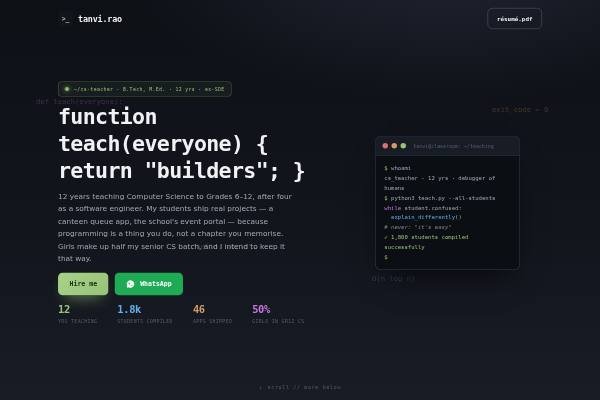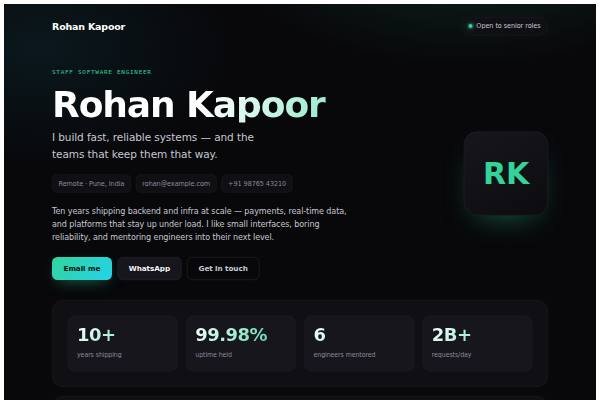
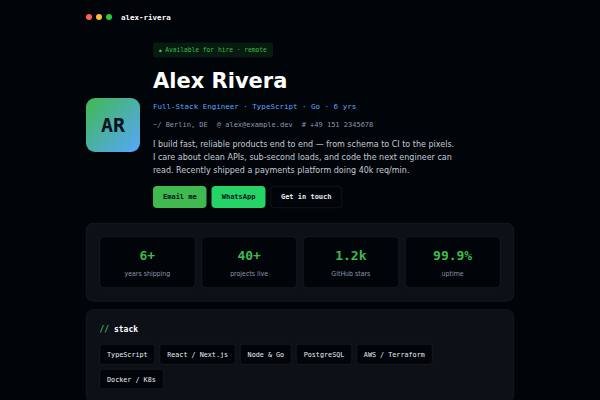
🧠 Personal website for Data Scientists

Show models that made it past the notebook

Data science hiring managers have seen the same Titanic and house-price projects hundreds of times. A personal site lets you present problems you framed yourself, the features and models you tried, how you validated them and whether anything reached production, which is what separates a working data scientist from a course certificate.

Claim your name: digitalcvmaker.com/

● Live in 5 minutes · free to start · no auto-renew

See it live

See a live demo of a data scientist website

Real designs filled in for a sample person (not a real profile). Open one, scroll it like a visitor would, then make yours free.

Before and after

Same person, same details — as a PDF and as a website.

Before: the resume Sample data scientist resume, page 1 of the PDF
Page 1 of the PDF
After: the website
The live demo website · Open it →

Does a data scientist need a personal website?

Yes — a data scientist benefits from a personal website, because hiring teams want to see how you frame a problem, build and test a model, and explain its limits. A site holds end-to-end project write-ups with code and evaluation, which résumés and certificate lists cannot show.

Why Data Scientists choose a personal site

Everything a data scientist needs, in one link

Problem framing first

Each project starts with the decision the model supports, not the algorithm you picked.

Validation you can defend

Baselines, metrics, leakage checks and error analysis written up so reviewers can trust your results.

Beyond the notebook

APIs, batch jobs or A/B tests that put a model in front of users, with your part spelled out.

Before you publish

What to put on your data scientist website

Tick off each item as you add it — and why each one matters to the people who read your site.

Page outline

How to lay out a data scientist website

  1. Focus statement Name your modelling area and domain, such as “forecasting and pricing models for retail” or “NLP for customer support”, with your level.
  2. End-to-end projects For each project cover the question, data sources, features, model choice, evaluation metric, baseline comparison and what was deployed or decided.
  3. Experiments and testing Explain an A/B test or offline evaluation you designed, including sample size reasoning and how you avoided leakage.
  4. Code and notebooks Link clean repositories with a README, environment file and short results summary; remove any employer data.
  5. Stack and depth Python, SQL, scikit-learn, PyTorch, Spark or MLflow, grouped by what you use daily versus what you have tried.
  6. Writing and contact Short explainers on methods you use, then your preferred roles, notice period and an email.
Templates

Website templates for data scientists

What data scientists in India should know before going online

Data science hiring in India covers product companies, banks and NBFCs, e-commerce, analytics consultancies and global capability centres, and job titles overlap with analytics and ML engineering roles. Recruiters often filter by Python, SQL and machine learning keywords, then send a take-home assignment, so a site with real modelling work gives you a head start. Many candidates show the same public datasets, so a project on Indian data, such as regional language text, monsoon-linked sales or public transport records, stands out. Banks and insurers here handle sensitive customer data under privacy rules, so never publish employer data even if anonymised by you. Kaggle rankings and course certificates help freshers, but hiring managers give more weight to clear problem framing and honest evaluation.

Common website mistakes data scientists make

  • Showing only accuracy numbers. Explain the baseline, the metric that matters for the business and where the model fails.
  • Filling the site with course projects on famous public datasets. Keep one if you must, and lead with an original problem.
  • Publishing notebooks that do not run. Pin package versions, include sample data or a download script and test from a clean environment.
  • Using real employer or client data in public repositories. Create synthetic data that mimics the structure instead.
  • Writing as if every reader is a statistician. Add a short plain-language summary of what the model does and why it matters.
How it works

From nothing to a live site in three steps

1

Pick a template

Start from a design built for professionals like you.

2

Make it yours

Add your details, work and photo — no code, no designer.

3

Go live and share

Publish to your own link and put it everywhere that matters.

Plans from Rs.499 a month · See plans

One place for your job

Everything for data scientists

FAQ

Questions from Data Scientists

Projects with an original question and messy, real data stand out: demand forecasting for a local business, churn for a subscription app or text classification on Indian-language reviews. Explain the baseline you beat, why the metric you chose fits the problem and what the model still gets wrong.

Yes, but don’t rely on them alone. A short write-up on your site tells reviewers what to look at, while the repository or notebook lets technical interviewers check your code, tests and whether the results can be reproduced.

Describe the business problem, the modelling approach and the impact in general terms. Leave out data, feature names and figures your employer considers confidential, and offer to discuss the technique in the interview. Rebuilding the same approach on a public dataset lets you show the code without risk.

Not always. Many roles in India centre on tabular data, forecasting, experimentation and classical ML. Show depth in what the roles you want actually use, and add deep learning work only if you can explain it well. A clean gradient boosting project with honest error analysis often impresses more than a fine-tuned model you cannot defend in the technical round.

Projects that go beyond tutorials: a clear problem, data cleaning, a baseline, models compared with proper evaluation, and what you would deploy. One end-to-end project with a working demo is more convincing than many notebooks.

An analyst portfolio centres on questions answered with SQL, dashboards and reports. A data scientist portfolio adds modelling, experimentation, evaluation and deployment.

Made for you

Personal websites for every profession

All professions →

Your name, your site, your callback

Join the Data Scientists who let their own site do the talking.

● Live in 5 minutes · free to start · no auto-renew

Chat on WhatsApp