🧭 Personal website for Product Managers

Show the product calls you made and what happened next

PM interviews dig into judgement: why you built one thing and not another, and how you knew it worked. A personal site holds short product write-ups covering the problem, the options you weighed, the launch and the metric you watched, which tells interviewers far more than a list of features.

Claim your name: digitalcvmaker.com/

● Live in 5 minutes · free to start · no auto-renew

See it live

See a live demo of a product manager website

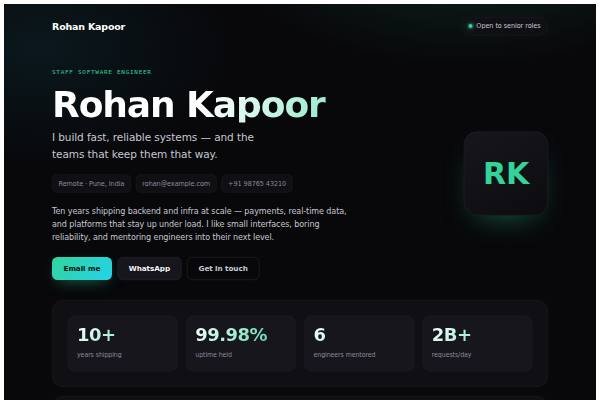
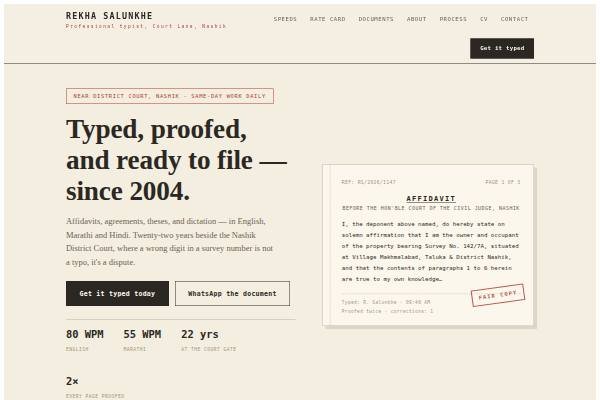
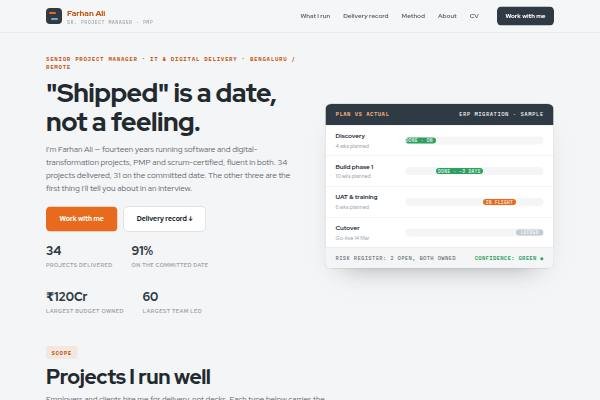
Real designs filled in for a sample person (not a real profile). Open one, scroll it like a visitor would, then make yours free.

Before and after

Same person, same details — as a PDF and as a website.

Before: the resume Sample product manager resume, page 1 of the PDF
Page 1 of the PDF
After: the website
The live demo website · Open it →

Does a product manager need a personal website?

Yes — a product manager benefits from a personal website, because PM hiring focuses on judgement: what you chose to build, what you dropped and why. A site lets you walk through decisions, metrics and trade-offs on a few products, which a one-page résumé and a LinkedIn headline cannot explain.

Why Product Managers choose a personal site

Everything a product manager needs, in one link

Decisions, not feature lists

Each write-up explains the user problem, the trade-off and why you chose the path you took.

Launches with evidence

Activation, retention or conversion movements described honestly, with your share of the credit.

Product sense on show

Teardowns or improvement ideas for apps you use show how you think when nobody is assigning work.

Before you publish

What to put on your product manager website

Tick off each item as you add it — and why each one matters to the people who read your site.

Page outline

How to lay out a product manager website

  1. Product focus Name the type of product and user, such as “B2B SaaS for logistics teams” or “consumer payments app”, plus your level.
  2. Decision stories For two or three launches cover the user problem, options considered, what you prioritised, the metric you watched and what you learnt.
  3. How I work Explain your discovery habits, how you write specs, run sprint planning and work with design, engineering and sales.
  4. Sample documents Share a redacted one-page PRD, a roadmap view or a launch checklist created with invented details.
  5. Background Note whether you came from engineering, design, consulting or operations, since it shapes how you work with teams.
  6. Contact and interests Mention the stage of company you prefer, location or remote, notice period and an email for recruiters and founders.
Templates

Website templates for product managers

What product managers in India should know before going online

Product management in India is spread across funded startups, large consumer internet companies, SaaS firms selling to global customers and global capability centres of multinational companies. Each looks for different signals: consumer companies ask about scale and experiments, SaaS firms ask about B2B discovery and pricing, and capability centres value stakeholder management across time zones. Many Indian PMs move in from engineering or consulting, so explaining that switch helps. Recruiters often ask about notice period early, and founders frequently hire through referrals and LinkedIn, where a link to your site travels well. Do not publish internal dashboards or unreleased plans; describe metrics as directions or relative changes unless they are already public. Products serving Bharat users or regional languages are a strong story if you have built for them.

Common website mistakes product managers make

  • Taking credit for the whole product. Say clearly which decisions were yours, and credit the team for the rest; interviewers probe this.
  • Sharing internal metrics or roadmaps. Describe impact in public or relative terms and keep confidential numbers out.
  • Listing features shipped without the user problem. Each story should start with who struggled and why it mattered.
  • Writing in heavy jargon. A founder or hiring manager should follow your write-up without decoding acronyms.
  • Leaving out failed bets. One honest story about a launch that did not work, and what you changed, shows judgement better than a perfect record.
How it works

From nothing to a live site in three steps

1

Pick a template

Start from a design built for professionals like you.

2

Make it yours

Add your details, work and photo — no code, no designer.

3

Go live and share

Publish to your own link and put it everywhere that matters.

Plans from Rs.499 a month · See plans

One place for your job

Everything for product managers

FAQ

Questions from Product Managers

Keep it to a page: the user and business problem, what you learnt from research or data, the options you considered, what shipped and the result. Note what you would do differently. Interviewers value that reflection as much as the outcome.

Use relative changes or ranges rather than absolute numbers, and leave out anything your employer treats as confidential. A clear method with a direction of change is safer, and usually just as convincing, as precise internal figures.

They do, if they go beyond opinion. Pick an app popular in India, identify a specific user segment and problem, propose a change and say how you would measure it. One thoughtful teardown beats five shallow ones.

A rough wireframe or a redacted PRD excerpt helps show how you communicate with design and engineering. Keep visuals simple; PM hiring rewards clarity of thinking, not polished design.

Two or three product stories, each with the problem, users, how you discovered what to build, decisions and trade-offs, launch and what happened after. Add writing samples such as a sanitised spec.

Start from your current role — engineering, design, analytics, sales or support — and take on product tasks there. Document small product decisions you influenced and show them on a portfolio site.

Made for you

Personal websites for every profession

All professions →

Your name, your site, your callback

Join the Product Managers who let their own site do the talking.

● Live in 5 minutes · free to start · no auto-renew

Chat on WhatsApp