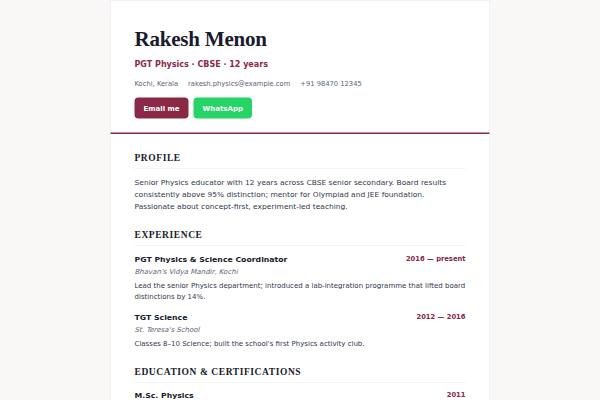
 Faculty Résumé
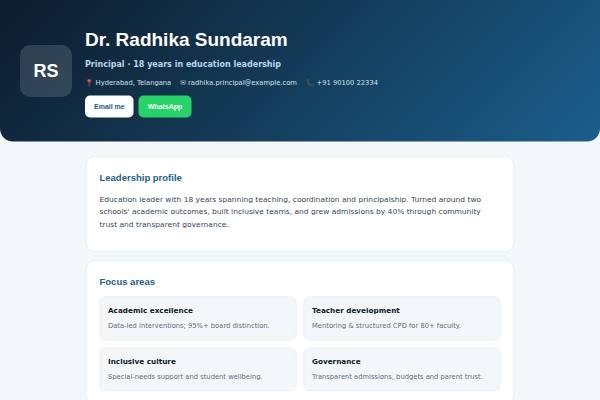 School Leader
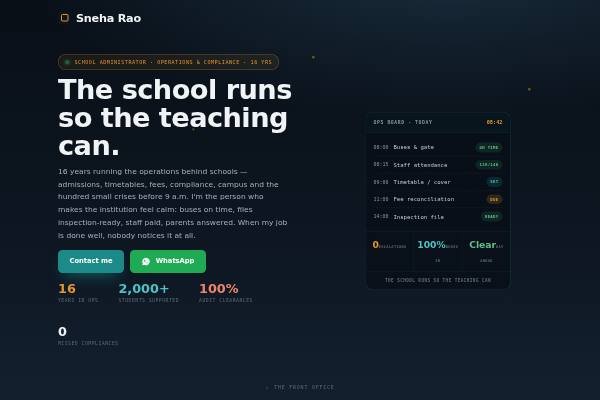 Ops
Ops

What school principals in India should know before going online
CBSE affiliation rules require every affiliated school to publish a mandatory public disclosure on its own website — details such as affiliation status, staff, fee structure, infrastructure and results — and several state boards and education departments have similar disclosure requirements. That information belongs on the school’s official site, not your personal one; your site should link to the school rather than repeat or contradict it. Boards also set eligibility conditions for principals, such as qualifications and teaching experience, so present yours accurately. Managements and school chains find principals through education networks, placement consultants, LinkedIn and Naukri. Be careful with student data: never publish identifiable children’s photos, marks or records without school permission and parental consent. Multilingual communication with parents is valued in most Indian cities.
Common website mistakes school principals make
- Copying the school’s fee structure, staff list or disclosure documents onto a personal site; link to the official school website where that information is maintained.
- Posting assembly and event photos with identifiable students; use photos without children’s faces, or only with school permission and parental consent.
- Claiming a school’s board results as your own achievement without context; describe what you changed and let the trend speak modestly.
- Writing a vision statement full of general phrases; give concrete examples of decisions you made on discipline, inclusion or teacher support.
- Letting the site suggest you speak for the school; add a line that views are personal and keep official announcements on the school’s channels.