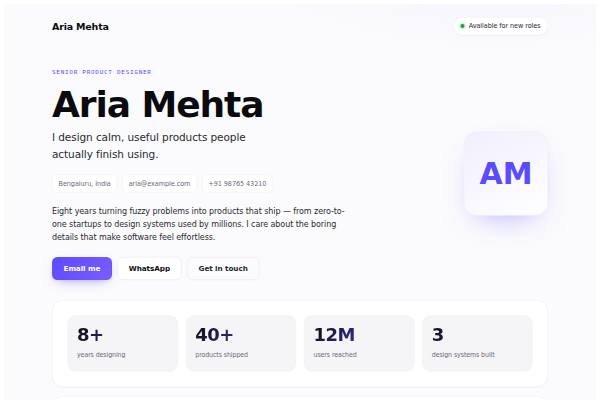
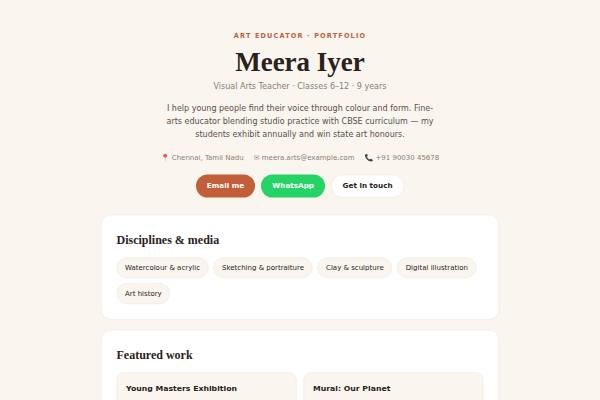
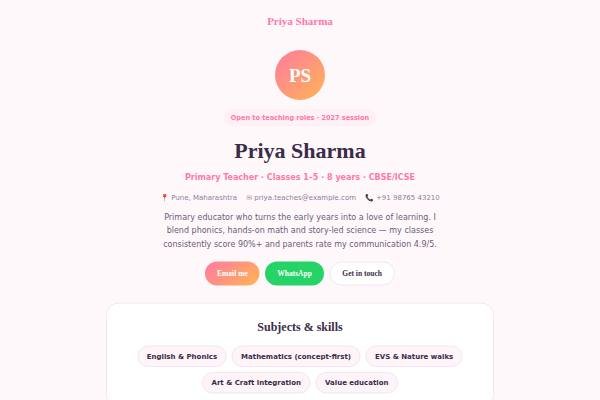
✍️ Personal website for Writers

A portfolio for your best clips — in one link

Editors and clients want to see your writing, fast. A personal site collects your best clips, your beats and your rates so a pitch turns into an assignment.

Claim your name: digitalcvmaker.com/

● Live in 5 minutes · free to start · no auto-renew

See it live

See a live demo of a writer website

Real designs filled in for a sample person (not a real profile). Open one, scroll it like a visitor would, then make yours free.

Before and after

Same person, same details — as a PDF and as a website.

Before: the resume Sample writer resume, page 1 of the PDF
Page 1 of the PDF
After: the website
The live demo website · Open it →

Does a writer need a personal website?

Yes — a writer benefits from a personal website, because editors and content managers decide on reading your actual prose. A site gathers your published pieces, beats and languages in one place, and keeps samples available after publications take articles down, change URLs or put them behind paywalls.

Why Writers choose a personal site

Everything a writer needs, in one link

Clips that load

Link your published work in a clean grid instead of a messy list of Google Docs.

Show your range

Group by beat or format so editors instantly see if you’re the right fit.

Pitch with proof

Attach one URL to every pitch and let the work make the case.

Before you publish

What to put on your writer website

Tick off each item as you add it — and why each one matters to the people who read your site.

Page outline

How to lay out a writer website

  1. Beat and voice statement Say what you write about and for whom, such as “long-form features on climate and agriculture” or “B2B SaaS blogs and case studies”, in your own tone.
  2. Best pieces by category Group clips by beat or format with headline, publication type, date and a one-line summary. Keep archived copies or PDFs in case links break.
  3. Languages and formats List the languages you write, edit or translate in, and formats such as features, scripts, newsletters, UX microcopy, speeches or books.
  4. Services and rates For commercial writing, describe services, typical word counts, research depth, revision rounds and rates per word, per piece or per retainer in ₹.
  5. About and background Your journey into writing, subject expertise from previous careers, education and any fellowships or residencies, told briefly and in your voice.
  6. Pitch and contact How editors and clients should reach you, what to include in a brief, and your turnaround expectations.
Templates

Website templates for writers

What writers in India should know before going online

Writing has no licensing body in India, so editors judge you on clips and reliability. Indian publications, brands and agencies increasingly want content in Hindi, Tamil, Bengali, Marathi and other languages, and writers who can work across English and one Indian language, or transcreate rather than translate literally, find more assignments. Content roles are advertised on Naukri and LinkedIn, while journalism and features often come through editor relationships and pitches. Under Indian copyright law, work made for an employer during employment generally belongs to the employer, and freelance commissions depend on the contract, so check rights before republishing full articles; excerpts with links are safer. Ghostwritten and brand content usually cannot carry your name, so describe it anonymously and share samples privately.

Common website mistakes writers make

  • Linking only to publication URLs that later break or go behind paywalls. Save a PDF or archived copy of every published piece and link that as backup.
  • Showing forty clips of mixed quality. Pick eight to twelve strong pieces per beat and retire older work that no longer matches your current level.
  • Republishing full commissioned articles without checking rights. Use a short excerpt with a link to the original unless your contract lets you reproduce it.
  • Hiding regional-language work because the site is in English. Add those pieces with a short English summary, since bilingual ability is valuable to many Indian clients.
  • Writing a bland About page. Your own site is a writing sample too, so make every page read clearly, in the voice you would bring to a client.
How it works

From nothing to a live site in three steps

1

Pick a template

Start from a design built for professionals like you.

2

Make it yours

Add your details, work and photo — no code, no designer.

3

Go live and share

Publish to your own link and put it everywhere that matters.

Plans from Rs.499 a month · See plans

One place for your job

Everything for writers

FAQ

Questions from Writers

Ask the client whether you can share a sample, or create an anonymised excerpt. You can also describe the project type, industry and word count without naming the client.

Yes. Grouping by beat, such as tech, finance or travel, or by format, such as blogs, scripts or UX copy, helps editors quickly see whether you fit their brief.

You can add content in any language you write in. Showcasing bilingual or regional-language samples can be a real advantage for Indian brands and publications.

Yes. Content and communications hiring managers like seeing live samples. One link with your best clips often says more than a cover letter about your tone and range.

Write three or four samples in the format you want to be hired for — a blog post, a case study, a feature — and publish them on your own site. Label them as samples and keep improving them.

Only if you can keep it updated. A few strong pieces that show your style work better than a blog with old posts. Your clips section can do the same job.

Made for you

Personal websites for every profession

All professions →

Your name, your site, your callback

Join the Writers who let their own site do the talking.

● Live in 5 minutes · free to start · no auto-renew

Chat on WhatsApp