
📐 Personal website for Architects

A portfolio as considered as your buildings

Architecture is judged on visuals and vision. A personal site gives your projects the full-width space they deserve and presents your studio with the polish clients expect.

Claim your name: digitalcvmaker.com/

● Live in 5 minutes · free to start · no auto-renew

See it live

See a live demo of an architect website

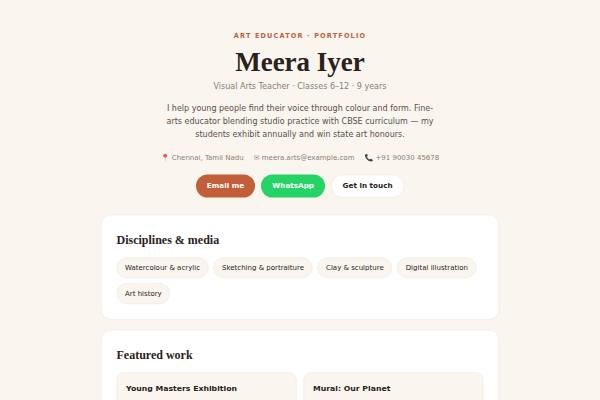
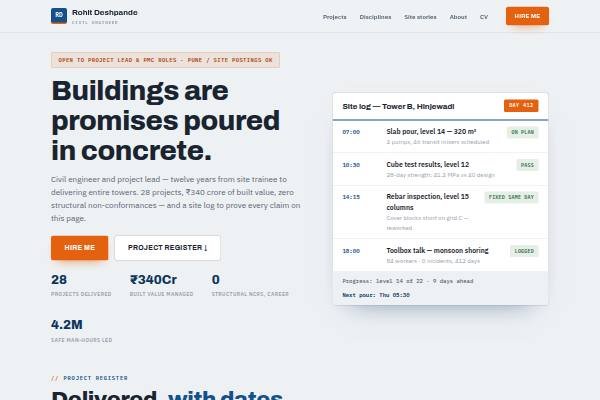
Real designs filled in for a sample person (not a real profile). Open one, scroll it like a visitor would, then make yours free.

Before and after

Same person, same details — as a PDF and as a website.

Before: the resume Sample architect resume, page 1 of the PDF
Page 1 of the PDF
After: the website
The live demo website · Open it →

Does an architect need a personal website?

Yes — an architect benefits from a personal website, because clients and firms judge built work, drawings and thinking together. A site presents projects with context such as site, brief, area and constraints, confirms your Council of Architecture registration, and helps homeowners understand how you work before they commit to a commission.

Why Architects choose a personal site

Everything an architect needs, in one link

Show the work big

Renders, plans and photography at full scale — not shrunk into a PDF.

Tell the concept

Pair each project with the thinking behind it, the way you would in a pitch.

Win the commission

A refined site signals a studio worth trusting with a serious build.

Before you publish

What to put on your architect website

Tick off each item as you add it — and why each one matters to the people who read your site.

Page outline

How to lay out an architect website

  1. Practice statement Describe the kind of work you do and where, such as “residential and small institutional buildings in coastal Karnataka”, with your approach to climate, materials or budget.
  2. Built projects For each, give location, typology, built-up area, your role, status and a short note on brief and constraints, with photographs, plans and sections.
  3. Unbuilt and competition work Clearly labelled concept, competition and academic projects that show design thinking, especially useful for early-career architects seeking positions at firms.
  4. Registration and team Your Council of Architecture registration number, qualifications, team members and consultants you work with, such as structural or services engineers.
  5. How a project works The stages from site visit and brief through design, approvals, drawings and site supervision, including what the client should prepare at each step.
  6. Project enquiry A form collecting location, plot size, project type, rough budget and timeline, so you can judge fit before the first meeting.
Templates

Website templates for architects

What architects in India should know before going online

Under the Architects Act, only persons registered with the Council of Architecture may use the title “architect” in India, so graduates awaiting registration should describe themselves accordingly. Show your registration number, as clients and authorities may verify it. The Council’s professional-conduct rules discourage self-promotional advertising, so keep the site factual and project-led, and check the current guidance before publishing fee details or claims. Homeowners usually find architects through referrals from friends, contractors and builders, then check photographs of completed homes and meet on site. Many clients in India are unsure what architects do beyond drawings, so explaining stages such as sanction drawings, working drawings and site supervision helps. Mention regions, local building bye-law experience and languages you use with contractors on site.

Common website mistakes architects make

  • Showing only renders without saying whether a project was built. Label each project as built, under construction or concept, so clients trust your images.
  • Using the title “architect” before Council of Architecture registration. Use “architecture graduate” until registered, then add the registration number.
  • Leaving out plans and sections. Clients and firms want to understand spatial thinking, so add at least one plan and a section to each key project.
  • Not explaining your scope of services. State whether you handle approvals, interiors, landscape and site supervision, so homeowners know what the fee will cover.
  • Using professional photographs without credit or permission. Credit the photographer and confirm your right to use the images on your site.
Real sites

Websites built by Architects

Real sites published by members — open one for ideas.

How it works

From nothing to a live site in three steps

1

Pick a template

Start from a design built for professionals like you.

2

Make it yours

Add your details, work and photo — no code, no designer.

3

Go live and share

Publish to your own link and put it everywhere that matters.

Plans from Rs.499 a month · See plans

One place for your job

Everything for architects

FAQ

Questions from Architects

Yes, clearly labelled. Competition entries and concept work show design thinking, while completed projects show you can deliver. A mix works well for both jobs and commissions.

Include location, typology, area, your role and the year, followed by a short note on the concept and constraints. Clients and firms want to understand your thinking, not just see images.

Yes. Practices often ask for a portfolio link along with a CV. A website lets you order projects by relevance and update them without resending large PDF files.

Many architects list their registration alongside qualifications for credibility. Keep content factual and within your professional body’s guidelines on how practising architects may present themselves.

A few projects with drawings, renders or photos, your role in each, the brief and how you responded, plus software skills and your registration if you are registered. Keep it lighter than a print portfolio.

Yes. Use studio projects and thesis work, show process sketches and models, and explain the brief. It is useful for internship applications and for sharing with firms when they ask for a link.

Made for you

Personal websites for every profession

All professions →

Your name, your site, your callback

Join the Architects who let their own site do the talking.

● Live in 5 minutes · free to start · no auto-renew

Chat on WhatsApp