Registration, licensing and visa rules change. Treat this as an overview and confirm every step on the official regulator and immigration websites before you apply or pay anyone.
Steps before your resume is read
- Pick a province and read its certification rules. Teacher certification is handled by each province and territory. In Ontario it is the Ontario College of Teachers, in British Columbia the Teacher Regulation Branch, and elsewhere usually a branch of the provincial education ministry. Each sets its own standards for academic study, teacher education and practicum. Check the current requirements for teachers educated outside Canada before applying, as rules change and a credential accepted in one province may fall short in another.
- Apply for certification with your documents. Applications usually require your bachelor’s degree, your B.Ed. or equivalent teacher education program, detailed transcripts and proof of supervised practice teaching. Many regulators want transcripts and program descriptions sent directly from Indian universities, sometimes with certified translations. Expect to explain the length of your B.Ed., because some provinces require a longer teacher education program, and a one-year B.Ed. may lead to a conditional certificate or extra courses rather than full certification.
- Prove language proficiency and clear background checks. Regulators may ask for an approved English or French language test unless your teacher education was completed in that language, and each regulator decides which tests count. Before you work with students, school boards require a criminal record check that includes a vulnerable sector check, and your regulator may also ask for police certificates from India. Allow time for these, since certification and hiring cannot usually be finalized without them.
- Sort out your immigration pathway. Certification does not give you the right to work in Canada. Most internationally trained teachers apply for permanent residence through Express Entry or a Provincial Nominee Program, while some arrive on a spousal or other open work permit. Rules and eligible occupations change, so rely on the official immigration website. Be cautious about recruiters who promise a guaranteed teaching post in exchange for a fee, since public school boards hire directly.
What to change in an Indian-style resume
- Replace Indian terms like Class VIII, PGT, TGT or PRT with Canadian equivalents such as Grade 8 or secondary mathematics teacher, keeping originals in brackets.
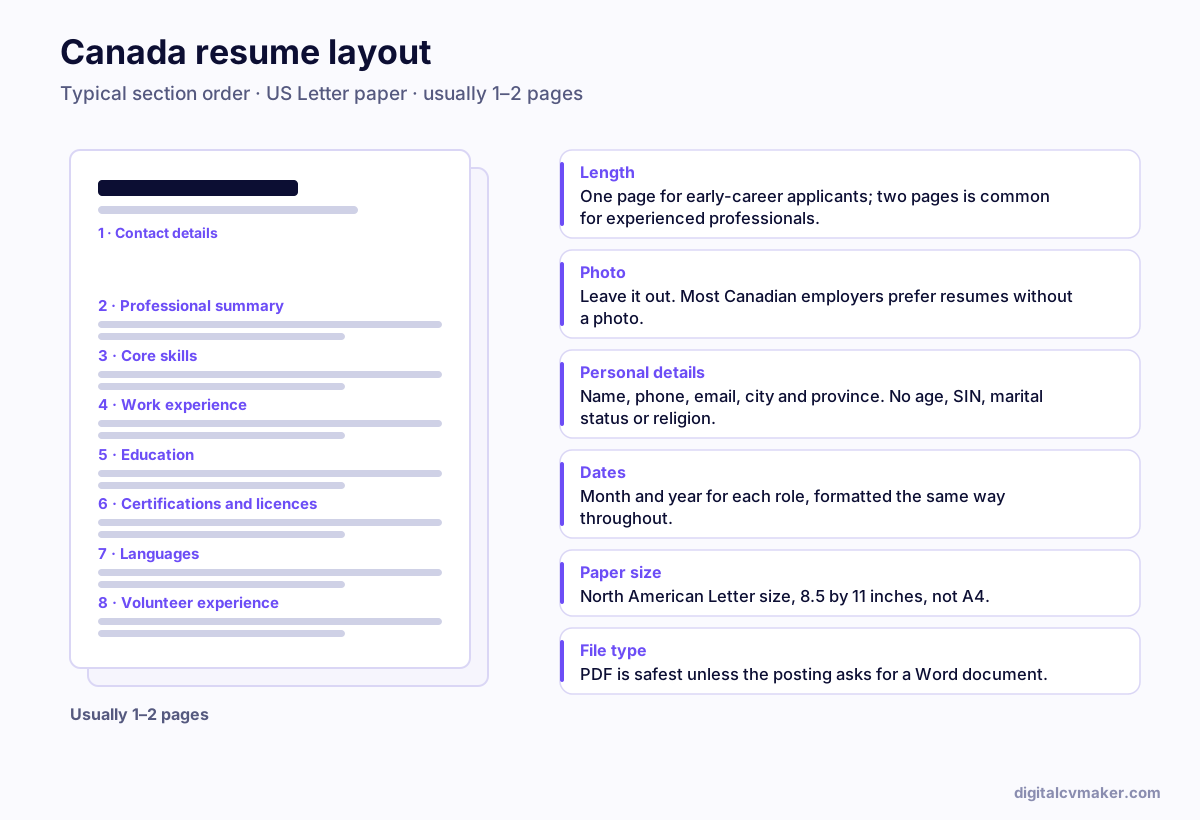
- Take out the photo, date of birth, marital status, religion and signed declaration common on Indian teaching CVs.
- Add a certification line showing your provincial status, such as application submitted to the Ontario College of Teachers, with the date.
- Swap board exam pass percentages for bullets on differentiated instruction, assessment for learning, classroom management and family communication.
- List teachable subjects and grade ranges clearly near the top, since Canadian boards hire by subject area and division.
Explain the school and board you taught in
Canadian principals will not know an Indian school by name, so add one line of context under each employer: a private CBSE-affiliated day school, a state government secondary school, or an international school following the IB program. Give the grade range, approximate student numbers and the language of instruction. If the school used English as the medium of instruction, say so clearly, because it supports your language credibility. Mention boards such as CBSE, ICSE or a state board only once with a brief explanation, then focus on what you did in the classroom rather than the syllabus.
Show class sizes and how you taught them
Many Indian classrooms have 40 or more students, which is well above typical Canadian class sizes. Stating your class size shows real classroom management experience, but pair it with evidence of how you reached individual learners. Describe small-group work, differentiated tasks, support for students with learning needs, and use of formative assessment such as exit tickets or quizzes. Canadian schools place strong emphasis on inclusion, student well-being and assessment practices that go beyond end-of-term examinations, so show concrete examples of each rather than listing board result percentages alone.
Present qualifications and teachable subjects
List your bachelor’s or master’s degree with the subject, then your B.Ed. with its length, the university and the year, and note any subject specialization or method courses. Canadian boards, especially in secondary schools, hire by teachable subjects, which are generally based on how many university courses you completed in a field. Make these obvious, for example mathematics and physics, or English and social studies. Add any Canadian qualifications you are pursuing, such as additional qualification courses in Ontario, and your certification status or number once you hold it.
Highlight communication, technology and extra activities
Canadian schools expect teachers to work closely with parents, special education staff and colleagues, so give examples of parent-teacher meetings, individual learning plans you contributed to, or team planning. Mention learning platforms and digital tools you have used, such as virtual classrooms, interactive whiteboards or online assessment tools. Extracurricular leadership also counts: coaching a sports team, running a science club, organizing a debate competition or leading a community service project. These details help principals picture you as part of the whole school, not only the timetable.
Sample profile and experience bullets
Secondary mathematics and physics teacher with nine years of experience teaching Grades 9 to 12 in English-medium schools in India. Plans differentiated lessons for mixed-ability classes, uses frequent formative assessment and keeps families informed about progress. Coached students for regional science fairs and led a peer tutoring program. Holds a B.Sc., M.Sc. and B.Ed.; application for certification with the Ontario College of Teachers is currently under review.
Taught Grade 11 and 12 physics to four sections of about 40 students each, using lab-based inquiry and weekly exit tickets to track understanding.
Designed a peer tutoring program pairing 30 senior students with Grade 9 learners, raising the share passing algebra assessments noticeably within one term.
Adapted assignments and assessments for six students with learning disabilities, working with the school counsellor and families on individual support plans.
Coached a team of eight students to a regional science fair, guiding project design, research methods and presentation skills.
Documents to keep ready
- Passport and proof of identity
- Bachelor’s and B.Ed. degree certificates
- Official transcripts sent from universities
- Proof of practice teaching or practicum
- Teaching experience letters from schools
- Approved language test results, if required
- Criminal record and vulnerable sector check
- Certified translations of non-English documents
Free Canada resume template
Laid out the Canada way, ready for your own details. No signup.