Registration, licensing and visa rules change. Treat this as an overview and confirm every step on the official regulator and immigration websites before you apply or pay anyone.
Steps before your resume is read
- Choose a province and check its regulator. Nursing is regulated province by province, so decide early where you want to work. Ontario uses the College of Nurses of Ontario, British Columbia uses the BC College of Nurses and Midwives (BCCNM), and every other province and territory has its own body. Requirements, routes and paperwork differ between them and are revised from time to time, so read the current guidance for internationally educated nurses on your chosen regulator’s website before paying for anything.
- Start the credential assessment. For many provinces, the first formal step has been an application to the National Nursing Assessment Service (NNAS), which collects your identity documents, nursing education records, registration history and employment verification and compares them with Canadian standards. Some regulators now let internationally educated nurses apply to them directly or use a different assessment path, so confirm with your regulator whether NNAS is still required. Ask your college and state nursing council early, since documents usually must be sent straight from the source.
- Meet the language and competency requirements. Regulators usually ask for proof of English proficiency through an approved test such as IELTS Academic, CELBAN or CELPIP, with the accepted tests and scores set by each regulator. Quebec works in French and has separate requirements. After reviewing your file, the regulator may ask you to complete a competency assessment, a bridging program or extra coursework to fill gaps, which is more common for diploma-trained nurses than for B.Sc. graduates.
- Pass the licensing exams. Registered nurse applicants outside Quebec generally write the NCLEX-RN, the computer-adaptive exam also used in the United States, once the regulator confirms eligibility. Some provinces add a jurisprudence exam on local law and professional standards. Practical nurse applicants take a different exam. Only after you pass and meet every other condition will the regulator issue registration, and that registration is what allows you to use a protected nursing title in that province.
- Plan your immigration route alongside registration. Registration and immigration are separate processes that often run in parallel. Many nurses apply for permanent residence through Express Entry, which has held draws aimed at healthcare occupations, or through a Provincial Nominee Program that targets nurses. Others come on an employer-supported work permit. Rely on Immigration, Refugees and Citizenship Canada and provincial government websites for current rules, and be wary of any agent who charges fees in exchange for a promised hospital job.
What to change in an Indian-style resume
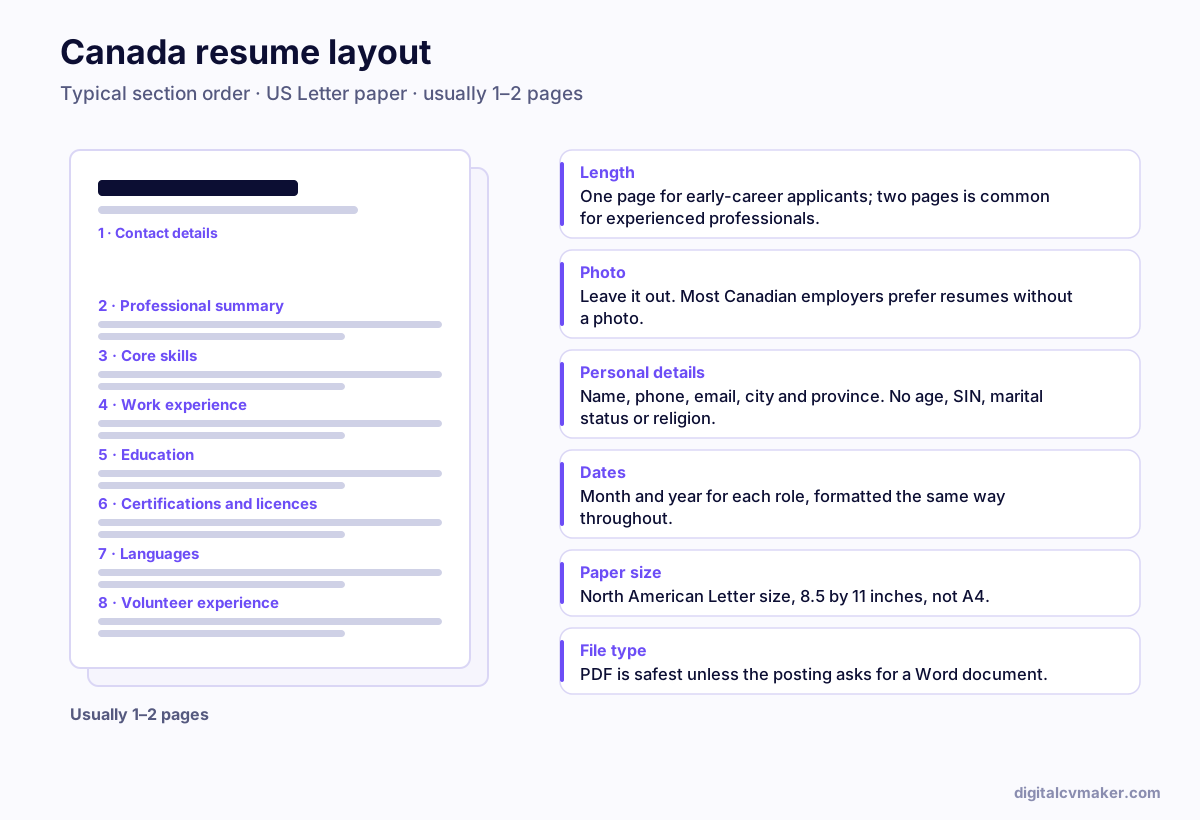
- Remove the photo, date of birth, religion, marital status, father’s name and the signed declaration that many Indian nursing CVs end with.
- Add a registration line near the top showing your NNAS or regulator application status, NCLEX result and Indian state nursing council registration.
- Replace long lists of duties with clinical bullets that show acuity, patient ratios, procedures performed and measurable improvements in care or safety.
- Translate Indian terms: explain GNM or B.Sc. Nursing, describe what a ward sister or staff nurse did, and name the unit type plainly.
- List certifications such as BLS or ACLS with the issuing organization and expiry month, and note any Canadian renewal already booked.
Describe the hospital and unit, not just the name
A Canadian recruiter reading an Indian hospital name has no idea whether it was a small nursing home or a large tertiary centre. Add a short line under each employer giving the type of facility, approximate bed count and main specialties, for example a multispecialty private hospital with around 400 beds and a cardiac surgery program. If the hospital holds NABH or JCI accreditation, mention it once in plain words, since it signals structured quality and infection control processes. Then name your unit precisely, such as medical-surgical, cardiac ICU, neonatal ICU, emergency or oncology day care, because Canadian postings are organized by unit type.
Show patient ratios, acuity and scope
Nurse-to-patient ratios in many Indian wards are much higher than in Canadian units, and that tells a hiring manager something useful about your organization and prioritization skills. State the ratio you typically handled on day and night shifts and the acuity of those patients. Then describe your scope honestly: medication administration, IV cannulation, blood transfusion monitoring, ventilator care, wound management or triage. Avoid claiming tasks that were done by doctors or technicians in your setting. Canadian scope of practice is defined by the regulator, so accurate description helps assessors and employers see where you already match and where orientation may be needed.
Present education and registration clearly
Give each qualification its full name, the institution, the state and the year, for example Bachelor of Science in Nursing from a college affiliated with a state health sciences university. Say whether the program was recognized by the Indian Nursing Council and include your state council registration number and status. If you hold GNM followed by a post-basic B.Sc., show both, because the regulator will review each. Add a separate line for your Canadian progress, such as NNAS advisory report received or NCLEX-RN passed, only when it is true. Clear, verifiable detail here saves you from repeated questions later.
Use Canadian job titles and nursing language
Titles like staff nurse, charge nurse, nursing in-charge or ward sister do not map neatly onto Canadian roles. Keep your original title for honesty, then add a short explanation in the first bullet, for example responsible for a 30-bed ward on night shifts, supervising four nurses. Use terms Canadian employers search for: patient assessment, care planning, interprofessional team, patient education, infection prevention and control, and documentation in electronic health records. Do not describe yourself as a registered nurse in Canada until you actually hold registration; instead, write internationally educated nurse or registered nurse in India, which is accurate and still clear.
Sample profile and experience bullets
Internationally educated nurse with seven years of acute care experience in cardiac and medical-surgical units at a 500-bed teaching hospital in India. Skilled in post-operative assessment, telemetry monitoring, medication safety and patient teaching for chronic disease. Completed the NNAS assessment and passed the NCLEX-RN; application for registration in Ontario is in progress. Known for calm handovers, precise charting and mentoring newly hired nurses through their first months on the unit.
Cared for five to seven post-operative cardiac patients per shift, completing hourly assessments and escalating early warning scores to the rapid response team.
Led a unit audit of medication administration records that reduced documentation errors by roughly 40 per cent over six months.
Oriented and precepted 12 newly graduated nurses on unit routines, telemetry interpretation and safe patient handling.
Delivered discharge teaching on heart failure self-care to patients and families, contributing to fewer early readmissions on the unit.
Documents to keep ready
- Passport and identity documents
- Nursing degree or diploma certificate
- Official academic transcripts and mark sheets
- State nursing council registration verification
- Employment verification letters from each hospital
- Approved English language test results
- NNAS advisory report or regulator decision
- Police certificates for immigration
Free Canada resume template
Laid out the Canada way, ready for your own details. No signup.