Registration, licensing and visa rules change. Treat this as an overview and confirm every step on the official regulator and immigration websites before you apply or pay anyone.
Steps before your CV is read
- Check eligibility and your English evidence. The Nursing and Midwifery Council (NMC) handles registration for nurses trained outside the UK. Start by confirming that your nursing qualification and your current registration with an Indian state nursing council meet its criteria. Most applicants then prove their English with either IELTS Academic or OET, reaching the scores the NMC sets at the time. Check the NMC website for the current rules, since accepted evidence and required scores are reviewed from time to time.
- Pass the computer-based test (CBT). The CBT is the first part of the NMC Test of Competence and checks nursing theory and numeracy. It is usually taken at an approved test centre, including centres in India, so you can sit it before moving. Passing the CBT and submitting your application and documents to the NMC often allows an employer to make a conditional offer while you prepare for the practical stage.
- Find a sponsoring employer and apply for the visa. Most Indian nurses travel on the Health and Care Worker visa, a form of the Skilled Worker visa. It needs a job offer from an employer licensed to sponsor, which then assigns you a certificate of sponsorship. Many NHS trusts and larger care providers recruit internationally and help with relocation. Apply directly or through recruiters that follow the UK code of practice for international health recruitment, and be wary of anyone charging you for a job.
- Sit the OSCE and receive your NMC PIN. The objective structured clinical examination (OSCE) is the practical second part of the Test of Competence, taken at an approved centre in the UK. Many employers book it for you and arrange preparation after you arrive, when you often work in a pre-registration role. Once you pass and the NMC completes its checks, you join the register, receive a PIN and can practise as a registered nurse.
What to change in an Indian-style CV
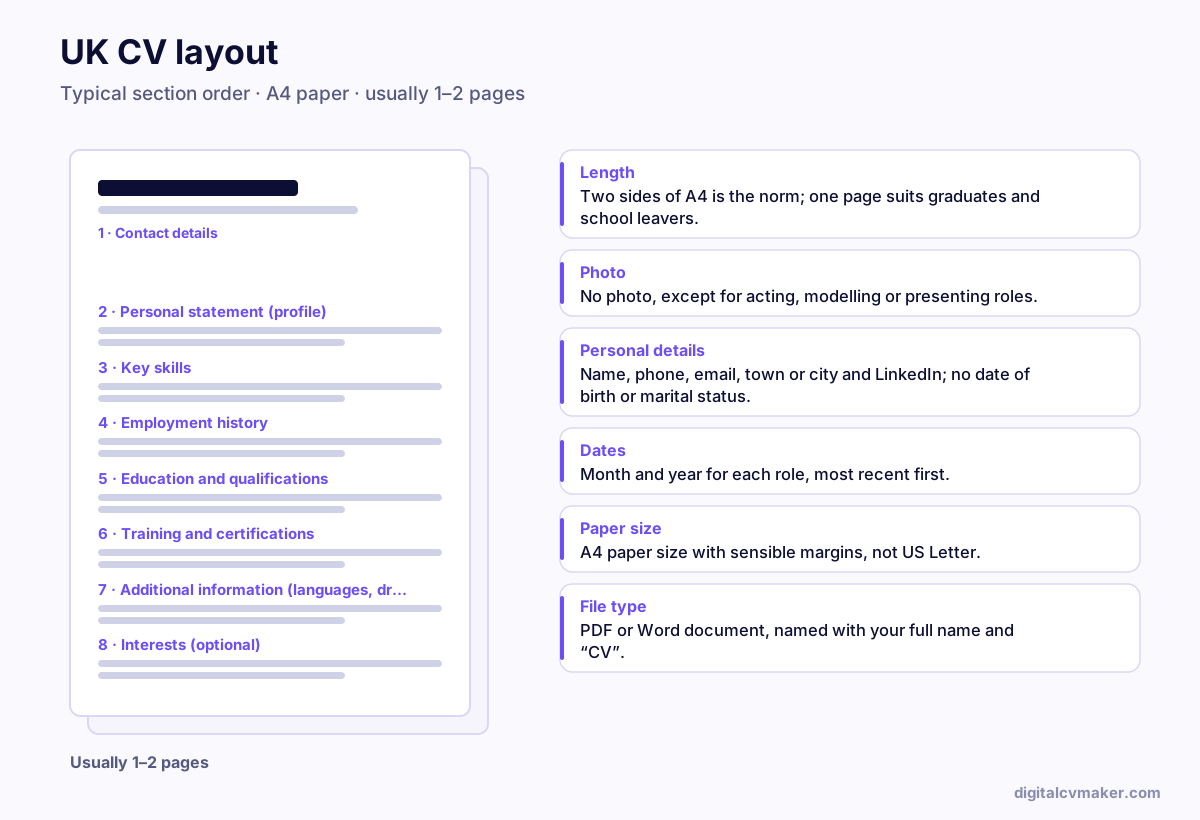
- Replace the photo, date of birth, religion, father’s name and marital status with a clean header giving your name, phone, email, city and NMC stage.
- Swap the career objective for a four-line profile naming your specialty, post-registration experience and your CBT, OSCE and English test status.
- Rewrite duty lists as outcomes: patients per shift, audits led, infection rates improved or new staff mentored, using figures you can support at interview.
- Translate Indian job titles and settings, for example staff nurse in a 30-bed medical ICU, so a UK reader can map you to a band and a ward.
- Move education below experience and drop school marks, keeping your nursing degree or diploma, council registration number and key clinical certificates.
Describing Indian hospitals for UK readers
A UK recruiter cannot tell whether an Indian hospital name means a small nursing home or a large tertiary centre, so add a short descriptor under each employer. Mention the type of hospital, such as corporate multispecialty, government medical college or charitable trust, the approximate number of beds and the unit you worked on. If the hospital holds NABH or JCI accreditation, say so in a few words, explaining that NABH is India’s national hospital accreditation. These details help the reader judge the acuity you handled and the standards you worked to without researching each name.
Showing clinical skills in NHS terms
UK nursing adverts often list competencies such as medicines management, early warning scoring, cannulation, venepuncture, catheterisation, wound care and discharge planning. Where you have done the equivalent task in India, use the UK term alongside your own. Group skills by area, for example critical care, theatres or elderly care, instead of one long list. State nurse-to-patient ratios honestly, such as one nurse to eight patients on a medical ward, since staffing levels differ and interviewers may ask how you prioritised care. Mention any electronic patient record systems you used, even local ones.
Specialty, shift leadership and teaching
Specialty experience is one of the strongest parts of an overseas nursing CV. Give each unit its own line with dates, especially ICU, theatres, emergency, dialysis, oncology, neonatal or mental health, because trusts often recruit for these areas separately. Include any time as shift in-charge or team leader and describe it plainly: staff supervised, beds covered and escalation decisions made. Teaching students from a college of nursing, running in-service sessions or acting as a preceptor for new joiners is worth adding, since mentoring and supervising learners becomes part of the job once you are on the register.
Qualifications, registration and training
List your BSc Nursing, Post Basic BSc or GNM diploma with the institution, state and completion date, and note that the course combined theory with supervised clinical placements. Add your state nursing council registration number and confirm it is current. Put life support courses such as BLS and ACLS, along with infection control or specialty certificates, under a separate training heading. Give your NMC progress its own line, for example “NMC CBT passed; OSCE pending”, and show your English result with the test name, so the recruiter sees your readiness at a glance.
Sample profile and experience bullets
Registered nurse with seven years’ post-registration experience in adult critical care and acute medicine at a 400-bed tertiary hospital in India. Confident managing ventilated patients, titrating infusions, leading shifts of six nurses and supporting families through difficult conversations. NMC CBT passed and OET completed, with OSCE preparation under way. Seeking a critical care staff nurse post with an NHS trust able to offer Health and Care Worker visa sponsorship.
Cared for up to two ventilated patients per shift in a 24-bed medical ICU, maintaining accurate fluid balance, sedation scoring and hourly observations.
Led night shifts for a team of five nurses and three nursing assistants, escalating deteriorating patients to the on-call doctor using structured handover.
Helped reduce central line infections on the unit by introducing a daily care bundle checklist and auditing compliance weekly with the infection control nurse.
Mentored 12 newly qualified nurses and nursing students through induction, running monthly teaching sessions on medicines safety and clinical documentation.
Documents to keep ready
- Passport valid for the visa period
- Nursing degree or diploma certificate and transcripts
- State nursing council registration certificate
- IELTS Academic or OET result
- NMC CBT result and application confirmation
- Experience letters from each hospital
- Tuberculosis test certificate from an approved clinic
- Police clearance certificate from India
Free UK CV template
Laid out the UK way, ready for your own details. No signup.