Registration, licensing and visa rules change. Treat this as an overview and confirm every step on the official regulator and immigration websites before you apply or pay anyone.
Steps before your CV is read
- Map your experience to UK job titles. Compare your experience with UK job titles, which tend to be simpler than Indian designations. A senior software engineer in the UK may cover what an Indian firm calls technical lead or module lead, and titles such as associate or consultant rarely translate directly. Read several adverts in your area, such as backend, data or mobile, note the stack and seniority they ask for, then describe yourself in those terms.
- Find an employer with a sponsor licence. Most Indian developers move on the Skilled Worker visa, which needs a job offer from an employer licensed by the Home Office to sponsor overseas staff. The UK government publishes a register of licensed sponsors, which is useful for checking an employer. The role must also meet the visa’s skill and salary rules, so confirm eligibility with the employer early rather than assuming every offer qualifies.
- Prepare your English and qualification evidence. The Skilled Worker visa has an English language requirement. A degree taught in English may satisfy it if you obtain the right confirmation from Ecctis, the UK’s qualification recognition service; otherwise an approved English test is usually needed. Gather degree certificates, transcripts and experience letters early, as the employer and the visa application may both ask for them.
- Consider other routes that may fit. Some developers qualify for routes that do not need a sponsor, such as the Global Talent visa for people with recognised achievements in digital technology, or the India Young Professionals Scheme for younger graduates, which is allocated by ballot. A move within your current employer under the Global Business Mobility routes is another option if it has a UK office. Check the official GOV.UK guidance for current eligibility before relying on any of these.
What to change in an Indian-style CV
- Cut the CV to two pages by removing the declaration, photo, personal details and school marks, and reducing projects older than about ten years to one line.
- Open each role with a one-line summary of the product or system, who used it and at what scale, before listing your achievements.
- Replace long technology tables with a short skills section grouped by languages, frameworks, cloud and data, listing only tools you could discuss in depth.
- Rewrite bullets around outcomes, such as latency reduced, costs saved, releases sped up or incidents cut, instead of phrases like “worked on” or “involved in”.
- Add GitHub, a portfolio site or published articles beside your contact details, and state your visa or sponsorship position in one plain line.
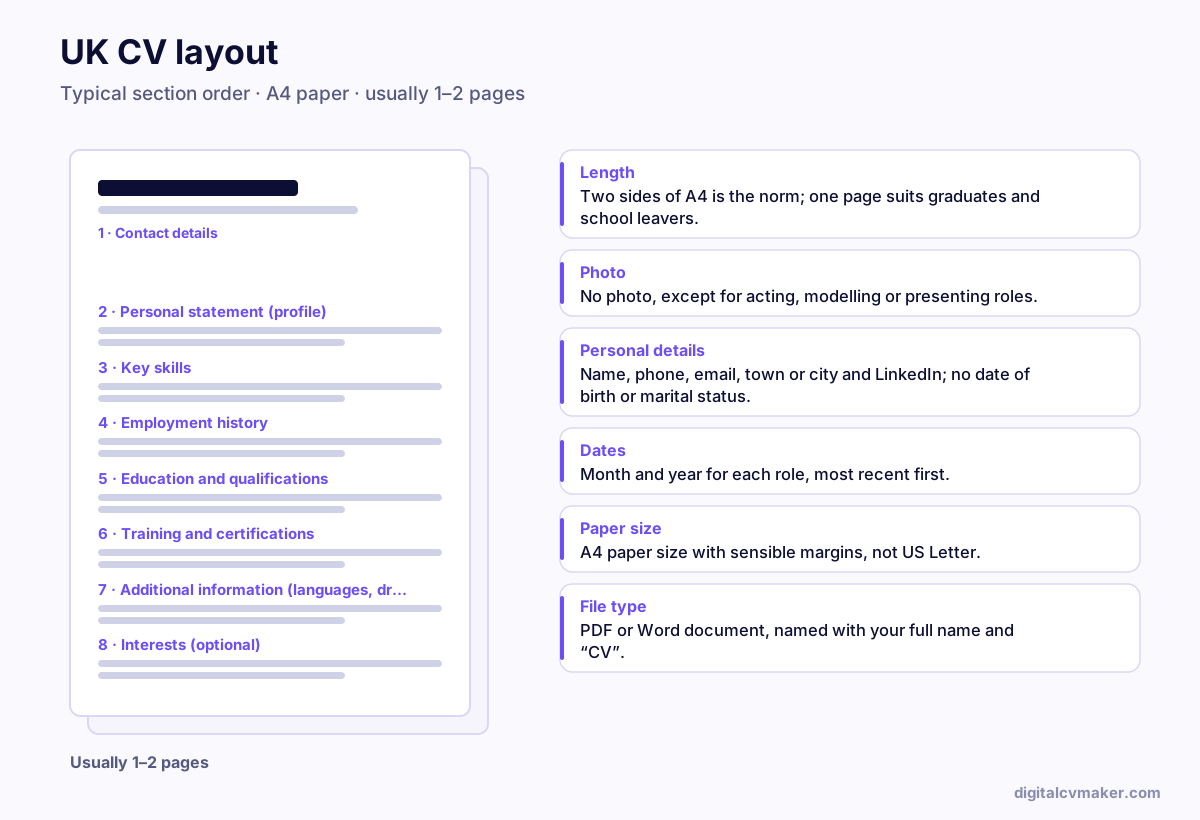
Presenting services-company experience
Many Indian developers work for IT services firms on client projects, sometimes for several clients in turn. UK recruiters understand this model but want to know what you personally built. Under each employer, list the main engagements as sub-headings with the client’s industry and your role, for example “Payments platform for a UK retail bank, backend developer”. If contracts stop you naming clients, describe them by sector and size. Highlight direct work with UK or European stakeholders, such as sprint reviews or on-call support in their time zone, because it shows you already understand how those teams operate.
Showing stack, scale and architecture
A UK hiring manager scans for stack fit first, then for evidence of scale. Mention languages and frameworks inside your bullets, not only in the skills list, so the reader sees where you used them. Give honest numbers for requests per second, data volumes, users or services owned, and name the architecture decisions you made, such as splitting a monolith or introducing event-driven processing. Include testing, CI/CD, observability and cloud platform experience, since many UK teams expect engineers to own code in production rather than hand it to a separate operations team.
Titles, seniority and years of experience
Indian job titles can look inflated or confusing in the UK market. Designations such as senior associate, member of technical staff or technology analyst mean little outside the company that uses them. Keep your official title for accuracy, then add a plain equivalent in brackets, such as “Senior Associate (Senior Backend Engineer)”. Let your bullets show scope, including code reviews, mentoring, design decisions and incident ownership. UK firms often weigh these signals more heavily than years of service alone, so a developer with five strong years may be considered for senior roles.
Education, certifications and side projects
Place education after experience unless you graduated recently. Give your degree as it appears, for example B.Tech in Computer Science, with the institution and city; there is no need for percentages or CGPA unless an employer asks. Cloud certifications from the major providers are recognised and worth listing by their full name. Open-source contributions, technical talks, competitive programming results and personal projects can set you apart, particularly when your employer’s code is private. Keep each to one or two lines with a link, so the reader can verify the work quickly.
Sample profile and experience bullets
Backend software engineer with six years’ experience building payment and order-management services in Java and Kotlin on a major public cloud. Designed APIs handling around 2,000 requests per second, led a move to event-driven processing with Kafka and cut infrastructure costs through right-sizing and caching. Comfortable owning services in production, reviewing code and mentoring junior developers. Looking for a senior backend role in the UK and will require Skilled Worker visa sponsorship.
Built a Spring Boot payments service processing about 1.5 million transactions a day, keeping monthly availability above 99.9 per cent for two years.
Reduced average API latency from 420 ms to 140 ms by adding Redis caching and rewriting slow PostgreSQL queries identified through distributed tracing.
Introduced contract tests and a trunk-based CI/CD pipeline, moving four product teams from fortnightly releases to daily deployments.
Mentored five junior developers through code reviews and pairing sessions, two of whom were later promoted to software engineer roles.
Documents to keep ready
- Passport with enough remaining validity
- Degree certificate and transcripts
- Ecctis statement or approved English test result
- Experience and relieving letters from past employers
- Certificate of sponsorship reference from your employer
- TB screening result, required for Indian applicants
- Bank statements showing maintenance funds, if required
Free UK CV template
Laid out the UK way, ready for your own details. No signup.