Registration, licensing and visa rules change. Treat this as an overview and confirm every step on the official regulator and immigration websites before you apply or pay anyone.
Steps before your CV is read
- Understand that you need a work permit, not a licence. Unlike doctors or nurses, software engineers do not register with a professional regulator in the UAE. Your right to work comes from a work permit and residence visa, which the employer arranges through the Ministry of Human Resources and Emiratisation (MOHRE), or through a free zone authority if the company is based in one. The job title on your visa matters, so ask how the employer will classify the role.
- Get your degree certificate attested. For most skilled work visas, your degree certificate must be attested. For an Indian degree, the chain usually runs through state-level authentication, then the Ministry of External Affairs, then the UAE Embassy or a consulate in India, and finally the UAE Ministry of Foreign Affairs. Start early, because a missing stamp can hold up the visa, and keep the original certificate in your hand luggage.
- Collect experience and relieving letters. Gather relieving and experience letters from every employer, with titles and dates that match your CV exactly. Some employers and background screening firms contact previous companies, and title mismatches cause awkward questions late in the process. If your Indian employer used an internal grade code instead of a title, ask HR for a letter that also states the role in plain words.
- Check rules in other Gulf countries. Neighbouring countries treat technical titles differently. In Saudi Arabia, visa roles with “engineer” in the title may need accreditation with the Saudi Council of Engineers, which can include checks on your degree. Qatar, Kuwait, Oman and Bahrain have their own attestation and permit rules. If a contract names a title your degree cannot support, raise it before you accept the offer.
What to change in an Indian-style CV
- Put a one-line technical headline under your name giving your main language, framework and cloud platform, rather than a generic “Software Professional”.
- Rewrite client-project bullets to name the industry and scale of each product, since Gulf readers rarely recognise internal Indian project names.
- Replace the long skills table rated in stars or percentages with tools grouped under backend, frontend, data, cloud and testing.
- Remove Class 10 and 12 percentages, date of birth and the declaration; keep your degree, institution and relevant certifications.
- Say whether you can relocate at short notice and whether your degree attestation is complete, since both shape how fast an offer moves.
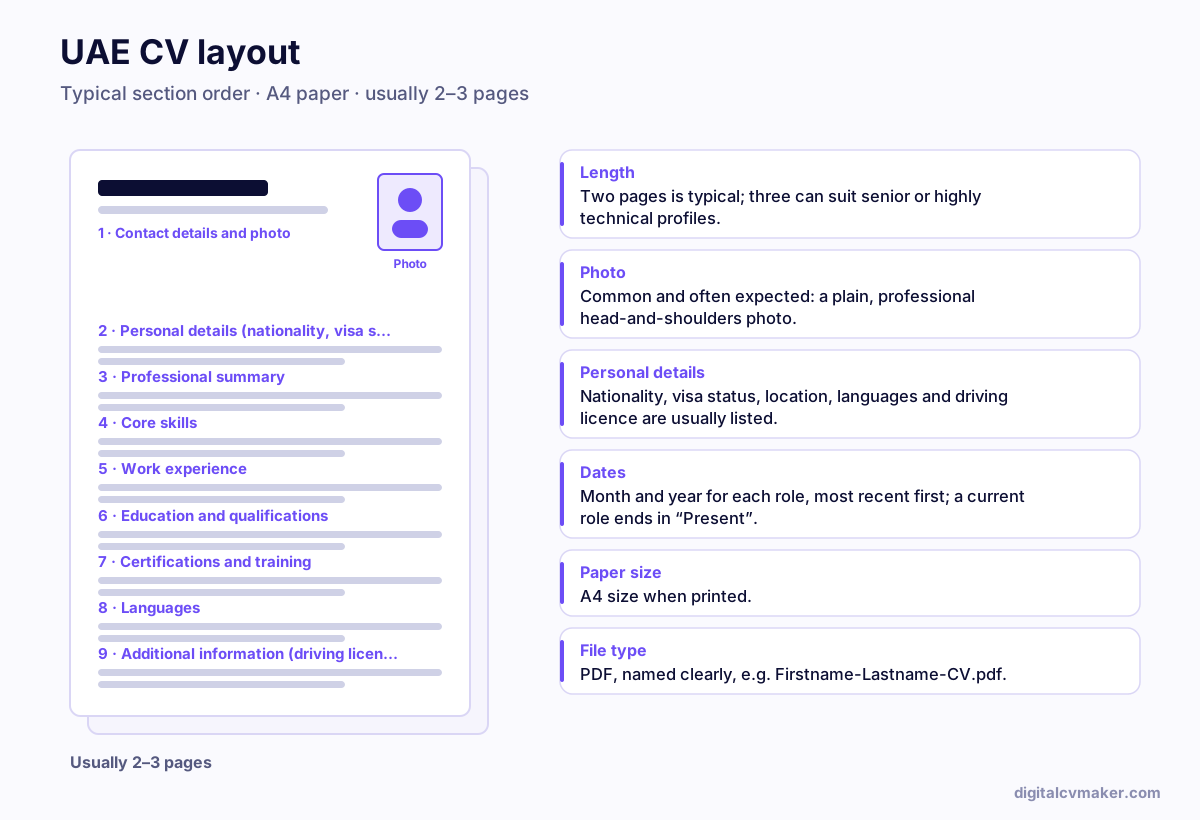
Presenting service-company and outsourcing experience
Many Indian developers spend years at IT services firms, working for one client after another. UAE employers value that range, but a list of project codenames tells them little. For each engagement, give the client’s industry and region, the product in one phrase, your role in the team and the team size. For example: “Payments platform for a European bank; backend developer in a squad of eight.” If you worked onsite in the Gulf for a client, say so clearly with the country and duration, since regional exposure counts. Leave out client names bound by confidentiality agreements and describe them by sector instead.
Showing scale, reliability and ownership
Hiring managers in Dubai’s product companies and banks want to know whether you have run software in production, not just written it. Give numbers where you can: daily active users, transactions per second, data volume, latency before and after your change, uptime targets, infrastructure cost saved. Show ownership through on-call duty, incident reviews, code review and mentoring. A bullet such as “cut p95 latency from 900 to 300 milliseconds” is far more convincing than “worked on performance”. If you are not sure of an exact figure, give a rounded range you could explain comfortably in an interview.
Matching what the Gulf tech market hires for
Technology hiring in the UAE is strong in fintech, banking, e-commerce, logistics, travel and government digital services. Look at the adverts you are targeting and mirror their language honestly: cloud platforms, microservices, mobile, data engineering or cybersecurity. Experience with Arabic localisation, right-to-left interfaces, payment gateways, identity verification or data protection rules deserves its own bullet, because these are regional needs that many applicants cannot show. Keep the skills list to tools you have used in production recently, and drop older technologies unless the job specifically mentions them.
Portfolio links, GitHub and certifications
Put your GitHub, personal website or portfolio link in the header beside LinkedIn, and pin the two or three repositories that best show clean, documented code. Never upload employer or client code. Cloud certifications from the major providers, and security or data credentials, are widely recognised in the Gulf and can help a recruiter screening hundreds of applications. List each with its full name and the issuing body. Open-source contributions, technical talks and published articles belong in a short section of their own, with a link and a one-line description of what you contributed.
Sample profile and experience bullets
Backend engineer with seven years’ experience building payment and order management services in Java and Spring Boot, most recently for a retail client processing around two million transactions a day. Designs event-driven systems on AWS using Kafka and PostgreSQL, and leads a squad of five engineers. AWS Certified Solutions Architect – Associate. B.Tech in Computer Science, degree attested. Based in Pune and ready to relocate to Dubai or Abu Dhabi.
Split a monolithic checkout service into six Spring Boot microservices on AWS, cutting p95 response time from 1.8 seconds to 450 milliseconds.
Built an Arabic and English localisation layer for a customer mobile app, including right-to-left layouts, used by around 300,000 monthly active users.
Automated deployment pipelines with GitHub Actions and Terraform, reducing release time from half a day to under 30 minutes for four teams.
Ran blameless incident reviews for payment services and fixed recurring root causes, bringing monthly production incidents down from nine to two.
Documents to keep ready
- Passport valid for the whole visa process
- Attested bachelor’s degree certificate
- Degree mark sheets or transcripts
- Experience and relieving letters from each employer
- Professional certification certificates
- Recent passport-size photographs
- Signed offer letter from the UAE employer
Free UAE CV template
Laid out the UAE way, ready for your own details. No signup.