Registration, licensing and visa rules change. Treat this as an overview and confirm every step on the official regulator and immigration websites before you apply or pay anyone.
Steps before your resume is read
- Check your immigration and work permit options. Tech workers typically reach Canada through Express Entry for permanent residence, a Provincial Nominee Program with a technology stream, or a work permit linked to a specific employer. Employer-specific permits often need a Labour Market Impact Assessment, though some technology roles can qualify for faster processing streams. Program rules, eligible occupations and invitation rounds change often, so confirm details on the Immigration, Refugees and Citizenship Canada website rather than relying on forums or agents.
- Get an Educational Credential Assessment. For Express Entry, a degree earned in India generally needs an Educational Credential Assessment (ECA) from a designated organization, such as World Education Services (WES). The report states the Canadian equivalent of your B.Tech., B.E., MCA or other degree. Your university usually has to send transcripts directly to the assessing body, which can take longer than expected, so begin early. Some applicants later mention the equivalency on their resume.
- Take an approved language test. Immigration applications require results from an approved language test, such as IELTS General Training or CELPIP-General for English, or an approved French test. Higher scores can improve your Express Entry ranking, and strong French can add further points. Note that the Academic version of IELTS is not the one used for most economic immigration programs. Check which tests and versions are accepted at the time you apply.
- Understand the engineer title before you apply. Engineering is a regulated profession in Canada, and provincial engineering regulators restrict who may call themselves an engineer or professional engineer (P.Eng.). Rules and enforcement vary, and some employers still use software engineer as a job title. To stay safe, many newcomers describe themselves as software developers in their summary and keep past job titles exactly as held, rather than claiming engineering status in Canada.
What to change in an Indian-style resume
- Cut the CV to two pages by merging similar client projects into a few strong bullets per employer instead of listing every engagement separately.
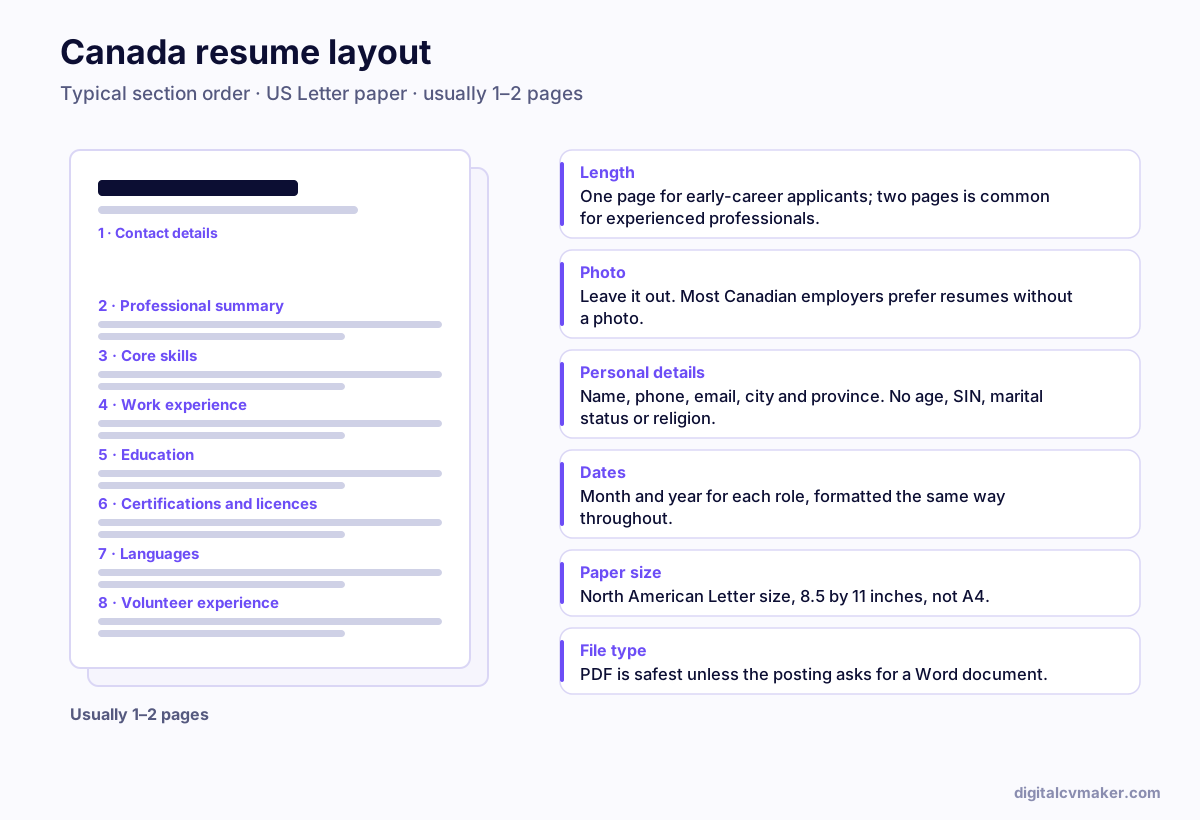
- Remove the photo, date of birth, gender, passport number and marital status that Indian services-company CV templates often include.
- Replace the long technical skills grid with a focused skills section grouped by languages, frameworks, cloud and data tools that match the posting.
- Rewrite responsibilities as outcomes, showing latency, uptime, cost, users served or release frequency improved by your work.
- Add your work authorization status and location near the top, for example permanent resident in Toronto or open work permit holder.
Explain services work and client projects
Many Indian engineers spend years at IT services firms, working on projects for overseas clients. Canadian recruiters understand this model but want to know what you personally built. Under each employer, give one line of context, such as a large IT services company, then describe work by client industry rather than naming confidential clients: a payments platform for a North American bank or an inventory system for a European retailer. Group short assignments together under one heading if they used a similar stack. Focus on design decisions you owned, systems you shipped and problems you solved, rather than the process steps every project followed.
Show scale with real numbers
Scale is one of the most persuasive things an Indian developer can show, since many products built in India serve very large user bases. State requests per second, daily active users, data volumes, number of microservices or size of the team, wherever you can do so without revealing confidential details. Pair each number with what you changed: reduced p95 latency from 800 to 250 milliseconds, or cut monthly cloud costs by about a fifth. Rounded figures are fine as long as they are honest and you can explain them in an interview, where Canadian hiring panels will often ask follow-up questions.
Present your stack the way Canadian postings do
Canadian tech postings usually list a specific set of languages, frameworks and platforms, and applicant tracking systems scan for them. Mirror that wording exactly, for instance TypeScript and React, Java with Spring Boot, Python, AWS or Azure, Kubernetes, PostgreSQL and CI/CD pipelines. Put the stack used in each role at the end of its bullets or in a single line under the job title, so the reader can see recency. Drop outdated tools unless the posting asks for them. Certifications from cloud providers can help, but practical evidence such as a GitHub profile or deployed side project usually carries more weight.
Translate titles and levels
Indian titles such as associate, senior software engineer, technical lead, module lead or member of technical staff mean different things from company to company. Keep your actual title, then make the level obvious through the content: the size of systems you designed, the number of engineers you mentored, and whether you owned delivery end to end. Canadian employers commonly use levels like intermediate, senior and staff developer, so a one-line summary such as senior developer with eight years of backend experience helps them place you. Do not inflate titles; reference checks with former managers are common in Canada.
Sample profile and experience bullets
Backend developer with eight years of experience building payment and order management services in Java, Spring Boot and AWS. Led a team of five that moved a monolith to event-driven microservices handling several million transactions a day. Strong in API design, observability and cost-aware cloud architecture. Permanent resident based in Toronto, with a Canadian equivalency for a four-year bachelor’s degree in computer science and ready to start immediately.
Redesigned the checkout API with caching and asynchronous processing, lowering p95 latency from 900 to 280 milliseconds during peak sale traffic.
Migrated 14 services from virtual machines to Kubernetes on AWS, reducing monthly infrastructure costs by about 22 per cent.
Introduced contract testing and trunk-based releases, increasing deployment frequency from fortnightly to several times a week with fewer rollbacks.
Mentored six junior developers through code reviews and pairing, with four promoted to intermediate roles within eighteen months.
Documents to keep ready
- Valid passport
- Educational Credential Assessment report
- Degree certificate and university transcripts
- Approved language test results
- Reference letters describing duties and hours
- Proof of settlement funds, if required
- Police certificates from countries lived in
- Job offer letter, if employer-supported
Free Canada resume template
Laid out the Canada way, ready for your own details. No signup.