⭐ Free tool · no signup

Free STAR Answer Builder

Write your Situation, Task, Action and Result, pick a target length, and get a natural spoken answer plus bullet notes — with checks for balance and measurable results. In a STAR answer the Action should be the longest part, because interviewers are mainly judging the steps you personally took and why you chose them.

Where and when, in one or two sentences. Only the context the listener needs.

0 words

What you were responsible for, or the problem you had to solve. Say “I”, not “we”.

0 words

The longest part. The steps you took and why — put each step on its own line and they will be joined with “first… then… finally”.

0 words

What changed because of you. Use a number if you honestly have one.

0 words
My answer bank (0)

Runs in your browser. Saved answers stay in this browser only and are never uploaded.

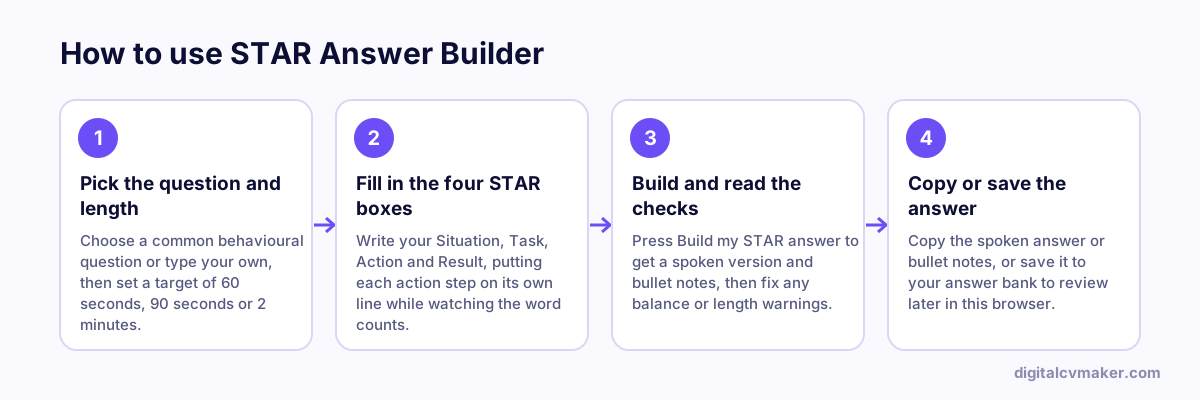
How to use STAR Answer Builder: 1. Pick the question and length, 2. Fill in the four STAR boxes, 3. Build and read the checks, 4. Copy or save the answer.
How to use the STAR Answer Builder, step by step.

How to build a strong STAR answer

  1. Choose a real example you can talk about for a few minutes if the interviewer asks follow-up questions.
  2. Keep the Situation and Task short. One or two sentences each is usually enough.
  3. Spend most of the answer on the Action: what you did, in what order, and why you chose that approach.
  4. End with a Result the interviewer can picture — a number, a deadline met, a problem that stopped happening.
  5. Say it aloud with a timer. If it runs long, cut background before you cut actions.

Build a small bank of stories

Five or six well-prepared stories can cover most behavioural questions: one about a problem you solved, one about a conflict, one about a mistake, one about leading or helping others, one about a deadline and one about learning something new. The same story can often answer two questions if you change which part you stress.

Worked example

A customer support lead answering a conflict question

What goes in

Question: Tell me about a time you resolved a conflict in your team. Target length: 60 seconds (about 150 words) Result as first written: The team worked better afterwards.

What you get

The builder flags the Result because it has no number and warns that the draft runs to about 210 words, well over the 150-word target. The lead moves detail out of the Situation, which had three sentences of background, and into the Action, describing the shared rota she set up and the one-to-one conversations she held. The Result becomes “Missed handovers fell from several a week to none in the next month”. The final answer is about 150 words, with Action as the longest part, which is where interviewers judge your own contribution.

Common mistakes

  • Spending most of the answer on the Situation, so the interviewer hears a long story and very little about the steps you personally took.
  • Using “we” throughout the Action, which makes it impossible to tell what you did yourself compared with what the rest of the team did.
  • Ending with a vague result such as “it went well”, when even an approximate number or a clear before-and-after makes the story believable.

When to use it: Use the STAR builder to shape one behavioural story carefully in writing; use interview practice when you want to rehearse many questions out loud.

FAQ

Frequently asked questions

STAR stands for Situation, Task, Action and Result. It is a simple order for answering behavioural questions such as “tell me about a time you…”: set the scene briefly, say what you were responsible for, explain what you personally did, and finish with what changed because of it.

The Action. Interviewers are judging what you did, so roughly half of your answer should describe your own steps and decisions. Situation and Task together should usually take only a few sentences. This builder warns you when the Action is shorter than the Situation.

Use a number if you honestly have one — time saved, errors reduced, people helped, marks or ratings. If you do not, describe a specific, checkable outcome instead, such as feedback from a manager or a process the team still uses. Never invent a figure you cannot explain.

Saved answers are kept in this browser’s local storage on your device only, and nothing is sent to a server. They stay until you delete them or clear your browser data. If your browser blocks storage, the builder still works, but saving is switched off.

Recruiters Google you before the interview

Get a page that shows up: your experience, projects and contact details at your own link. Live in minutes.

Start free
Chat on WhatsApp